The hidden track titled "Write It Out" from Dashboard Confessional's album Dusk And Summer has recently been added into my list of favorite songs. Ever.
Why? The answer is simple. The song is written as a powerful and poetic narrative. The only way I can sincerely enjoy "Write It Out" is to sit down and listen to it. No multitasking. No skimming over the words. I get comfortable and close my eyes and listen to the words as they ride the ebb and flow of the instruments in the background. My mind runs free and follows the words and I enjoy this guided mental excursion into my own imagination immensely.
I prefer this Grooveshark link to the song with its high quality audio, but if you're too lazy to click the link (REALLY?!), here's a lower quality Youtube embed.
Yeah, I try to write it out, not sure what I recall I can’t tell if it’s memory or story telling now It happened very quickly but it seemed to last for hours And everything was crisp and clean till all came crashing down
So much fire and debris that I was nearly blind with panic, and there was no one anywhere to turn to be saved from the tyranny and cavalcade. And all use was lost.
And the more that I would struggle, the more that I became entwined And the thickets & the thorns became my flesh and I was vine. Creeping deep into the pavement, breaking ground as I grew fast To the center of the city and up again where I did gasp In the air, oh to breathe, and I was still alive with a start
And there were people everywhere to behold and admire And I longed to be one of them and though I was lost I felt familiar with my surroundings, though they didn’t look quite right Like someplace that I had been before, under cover of night.
And I found my way by light of day to the center of a crowd and told them I was one of them and begged them for their help. And with stones they took their aim, and I knew I would die at their hands Where I was crowned a heretic to be loathed and set fire and laid upon funeral pyre.
And as I cast my eyes to the sky I felt your touch, so gentle and so soothing that I knew I had been saved, but my movements were so labored and my will had been betrayed But my lips they work alone now and to them I am enslaved. And the slightest indiscretions that I made were met with rage And I burned to be free and then you rescued me with your voice and beckoned me beside you and your touch was alive. Sensational and vibrant and with care and your words...
You say “A secret is a stealthy thing, you cannot know its plans. You were only dreaming, dear, and now you’re here with me again.” You ask if I’d account to you the spirit of my night And you handed me this pad and this pen with which to write. While it’s fresh in your mind, before it gets away...
Starting 2011 off with a nice upper/lower split across a four day week, hoping to work out on weekdays and use Wednesday as a rest day. This is just a tentative program, to ease myself back into the workout groove with reasonable intensity. Hoping to slowly decrease reps per set to around 2-4 for the big compound lifts in a couple weeks.
Lower B Deadlift - warm up + 3 sets - 6-8 reps Leg Press - warm up + 3 sets - 8-10 reps Leg Curls - warm up + 3 sets - 8-10 reps Skull Crushers - warm up + 3 sets - 6-8 reps Buddy Curls - 8-10 reps
Might switch up the program next month a la the Triphase Training program's periodization. One of the big goals for the next month is to use the lower days to really focus on improving core/lower back strength to do reasonably heavy lifts without a belt as well as squat deeper than I ever believed possible.
My workout partner's pumped and ready and so am I! It's time to kick my metabolism back into high gear and put on some mass, I believe.
On January 8th, 2011, an article titled "Why Chinese Mothers Are Superior" appeared on the Wall Street Journal website and entered the internet world. Written by Amy Chua, a professor at Yale Law School, the article expounds on the idea that there are two kinds of parents, the "Chinese" parenting method and (quite awfully) any other approach to parenting, and that there is nothing that can beat a "Chinese" parent. Rock may crush scissors, and scissors may cut paper, but NOTHING beats a Chinese parent.*
Why the mess in the world would she write this (for the Wall Street Journal, no less)?! Because she can back it up, apparently. In short, she believes that her Chinese parenting method leads to more successful children. Of course, this delves into the subjective territory of the definition of a parenting "success". So what traits does a "successfully" parented child display? In Chua's mind, the traits of successful "Chinese" children go something like this: blind obedience, constant meeting of ridiculously strict academic standards ("ALWAYS MAKE STRAIGHT A'S AND YOU MUST BE SCHOOL NUMBER ONE AND GO TO YALE OR ELSE"), to feel guilty for being called names like "garbage" by a parent, and many, many more stupid things.
Well y'know what?
SCREW YOU, AMY CHUA. YOUR IDEAS ARE TERRIBLE AND THEY MAKE ME RAGE.
COMMENCE RAGE IN THE FORM OF A BULLETED LIST.
Things that are wrong with Amy Chua's reasoning:
Chua creates a false dichotomy by setting up things so that every child either succeeds by meeting all of her expectations under fucked up "Chinese" parenting or fails. Basically, Chua turns life into a pass/fail class with ridiculous passing standards to make her point.
A good point is also made in fact that not everyone can always be #1, or even #2 or #3. There are not enough high schools in America for us to send all Chinese teens to different high schools for them to be valedictorians. This basically means Chua's "superior" parenting method sets up an unfair ratio of almost-certain failure to possible success, effectively making many children impossible failures.
Oh, and you can't ever beat "Chinese" parenting with "Western" parenting because, y'know, life just doesn't work that way.
Chua believes that "what Chinese parents understand is that nothing is fun until you're good at it." What kind of crap is this? Many things can be fun without being perfected to ridiculous standards. And in Chua's world, to be "good at" means to excel above everyone else.
Chua creates an is-ought gap when she observes that the "Western" method of allowing a young child to learn piano at a slower pace is wrong and ought to be replaced with the Chinese method of coercion. There is very little connection between "little child taking a long time to learn something that is not extremely important" and "little child should be coerced into learning quickly against his/her own will". A discrepancy in causal attribution across the different "cultures" of parenting styles does not necessarily mean that the "Western" method is unalterably incorrect.
It seems to me that Chua wouldn't be past waterboarding a young child in order to "coerce" him/her to practice piano/violin since the pain and terror generated is only temporary, right?
And of course, somehow Chua's cost-benefit analysis totally says that the "The Little White Donkey" on piano is worth the anguish and torment of "no lunch, no dinner, no Christmas or Hanukkah presents, no birthday parties for two, three, four years" and being called "lazy, cowardly, self-indulgent and pathetic".
Chua makes a halfhearted attempt at deciphering the (faulty) reasoning behind why "Chinese" parenting unconditionally assumes that "Chinese parents believe that their kids owe them everything"; she chalks it up to something along the lines of Confucian filial piety and parental sacrifice. Perhaps if she dug a bit deeper, she would also find the Confucian writings on the ethic of reciprocity and mutual respect that goes HAND-IN-FRICKING-HAND with said filial piety. Y'know, Amy, coercion isn't a reactant I'd use in a reaction to yield "mutual respect" and "positive reciprocity".
Her inclusion of her (Western *GASP*) husband's response that "children don't choose their parents" is dismissed offhandedly as the opinion of the non-"Chinese", who are obviously nothing but terrible parents.
Chua also proposes a straw man argument by implying that any non-"Chinese" parenting method CANNOT measure up to (or exceed) the "Chinese" expectations.
Chua assumes there is no breaking point in "Chinese" children and that no matter what kind of shit you decide to pull on your children, they will always be okay with it and assume it was "out of love". Because, you know, "worthless", "a disgrace", "stupid", and "garbage" are all just terms of endearment to make your kid try harder. And your kid knows that. Right?
"I once did the same thing to Sophia, calling her garbage in English when she acted extremely disrespectfully toward me," boasts Chua. Why is this supposed to be okay? This seems to teach "it's okay to call people names when they are not doing what you want." Also, with my experience with "Chinese" parenting, Sophia probably did something like ask "why must I do this? I don't understand" and refuse to stay happy with the answer of "because I am always right and you are always wrong". Yep. Garbage she is!
Chua even goes onto say that "Chinese mothers can say to their daughters, 'Hey fatty—lose some weight.'" What the HELL? ALL mothers can say that to their daughters. Most don't because it's hurtful and shallow and flat out hurtful. I know more than one "Chinese" girl who does not like it and feels hurt when her mother calls her fat (which happens frequently). ETHIC OF RECIPROCITY, YOU. Try not to let your pick-and-choose Confucian ethics hit you on your way out.
No breaking point? You sure, Amy Chua?! Ever heard of Esmie Tseng? Poor girl snapped. Way to go, "Chinese" parenting.
Chua hates individualism. There is no such thing in little children. There is no breaking point for when the children will crumble to your coercing (her word!) things out of them to conform.
Chua forgets to mention that aggressive corporal punishment bordering and sometimes crossing into physical abuse has traditionally been generally very well tolerated in her "Chinese" parenting method. Guess the Wall Street Journal probably wouldn't have been too happy if she started endorsing THAT indispensable part of making children obedient as well.
The "Chinese" parenting method does not give any points for success in personal interests aside from piano/violin/math/science and places no importance on being well-adjusted.
"Anyway, the understanding is that Chinese children must spend their lives repaying their parents by obeying them and making them proud," Chua admits. So basically, "Chinese" Parenting Rule Number 1 is "don't question me or my motives ever because I am always right and you owe me your life." (I went through most of life thinking it was "don't talk about 'Chinese' parenting" which I thought was also the same as Rule Number 2—"don't talk about 'Chinese' parenting'.)
"打是愛,罵是疼。" Hitting is love, cursing is doting/fondness.
There's actually a Chinese saying that I was raised to. Being taught that physical violence and loud escalation of conflict are loving displays of well-adjusted problem solving behavior... I'm glad I learned better. This was seriously one of the rationalizations I was taught for being raised under a relatively "Chinese" roof.
So yes, I was raised relatively "Chinese" and I turned out alright. Am I happy with it? Relatively, I'd say. While I do not exactly agree a lot of the things I was put through, I have to say it was better than being locked in a room with windows or lights and being fed bread crumbs and expired condensed soup for 19 years. More realistically, I'd say my upbringing was better than that of many people I know. However, just because the resiliency of the human soul can overcome some pretty big mess-ups in parenting does not mean that the mess-ups should be collected together and endorsed as be-all and end-all paths to success.
This one's for all the angry "Chinese"-raised kids out there. We can be right sometimes, right? Nah, probably not. I find tongue-in-cheek humor in the fact that Chua's article is an excellent example of the classic "Asian mom" distorted reality that we all talk so much about. Or maybe the other angry Asian bloggers are onto something with their first impression that it may be a piece of Swiftian satire.
-b.
Bonus: My reasoning for why "Chinese" parents try to force violin and piano on their children: the violin and piano are two of the most attention-grabbing instruments. The piano is often a solo performance instrument and the violin offers the child a chance to be forced to aim for the coveted concertmaster seat ("YOU MUST BE NUMBER ONE VIOLIN IN CLASS OR ELSE!"). This attention-grabbing quality means the "Chinese" parent is given more opportunities to pass/fail the child. Plus, it fits perfectly with the "start coercing early" step of the parenting method, since the earlier you coerce a kid into practicing, the quicker he'll get better than his peers, who may be too busy building things with legos or eating Play-Doh.
Bonus 2: I used the international rules on quotation marks this time!
Bonus 3: See? Western parenting is NOT in any way full of failures.
This is a melody that has been rattling around my head for the better part of a week. I sat down at the piano to record it so that I could just listen to it instead of having to walk over to the piano to play it again. I came up with all the fun stuff on the spot... a fun little creativity workout. Oh, and there is also a Beatles song that makes a cameo around 1:05-ish (you can guess which one).
If anyone recognizes the main melody PLEASE TELL ME WHERE I AM STEALING THIS FROM... or else I will be the proud owner of an original melody.
/end monologue
I have a faulty security alarm at my new apartment that won't stop going off every 10 seconds. I have subconsciously convinced myself that it is the sound a birds chirping with all of nature's glory in my house (a very consistent bird, indeed).
I suppose I shall record more of the improvised stuff that keeps coming to mind lately. It will be even nicer when I bother to get the front office to fix my bird chirping issues.
If this unnamed melody is not someone else's intellectual property... I feel like I should designate it as my work theme--a theme to be added to the life of B Original Soundtrack, played during late night studying/project finishing montages of me.
-b.
Oh, and a download link HERE if anyone gets this as stuck in their head as it is in mine.
"You've got a really strong will from what I can tell, and you have a quiet integrity about you."
This is what someone told me. I felt like I understood a bit of what she meant, and the words "quiet integrity" stuck out in my mind. I felt like I had an idea of its meaning, but it was more of a hazy collection of connotations than an actual meaning. So I dug deeper.
Quiet integrity.
Quiet => soft-spoken.
Integrity => soundness of morals/character.
So this suggests that my friend believes that I have a soft-spoken moral soundness. I dig it.
I may not have to be the loudest or most decisive person in the room, but I feel like I am usually one who makes sure to put things in perspective and think deeply.
"You don’t have to change just to fit someone else’s expectations."
Whether it finds its way into your life as a declaration or a seemingly wise piece of advice, I am sure that you've heard it at one point or another. Girls and guys love to parrot this to their friends as if it were the golden rule toward self-actualization and contentment. It may not be phrased the same way every time, the core meaning is clear: do NOT change anything about who you are for anyone or anything.What do I find wrong with this? The implication.
The implication: Change is bad. Do not change.
While I can see certain situations in which this "advice" could be a useful mantra to keep (like avoiding dependency and corruption by self-destructive forces), there is still absolutely no reason to condone the classifying of ALL outside change as hurtful.
I am against it because a) it is a lie (a thought-terminating cliché, even) and b) it can become a caustic threat to personal growth.
Why and how is this destructive and dangerous to personal growth?
Followers of this "don't change for anyone" advice begin to blindly categorize all attempts to change them as personal attacks. If you ask me, I feel like this is definitely a factor in a significant number of so-called "attitude problems."
Good changes and positive influences find themselves shut out due to the conditioned kainotophobia that stymies their impact. The hindered impact of positive influences seems to result in a difficulty progressing and growing.
The scariest part of this is that those who take this piece of "advice" to heart end up thinking that they are working toward their own welfare when they are actually hurting themselves.
How do we fight against this? To ensure that we do not fall prey to this fear of change, we have to consciously weigh our options whenever we can and be intelligent about the choices we can make and the changes we allow (instead of subconsciously lumping them all into a discard pile). For example, the influence that pressures you into doing meth and the influence that pressures you into wearing more flat-front shorts instead of cargo shorts should not get lumped together into the same category of proposed "change", right?
"Life is like playing a violin in public and learning the instrument as one goes on."
- Samuel Butler
-b.
PS: I've also heard "don't change for anyone but yourself." While an improvement on the original, this variation is still not quite satisfactory. It is not possible to always be the instigator of change--sometimes one has to be flexible and adaptable. Sometimes a change may require a leap of faith in an outside force that, for a lack of a better expression, "knows best."
PPS: I doubt anyone else will realize this, but in this post, I chose to deviate from my usual following of international standards when using periods and commas with quotation marks. The British/international custom is to allow the commas and periods to lie wherever they fit best, naturally; the American English custom is to include them within the quotation marks at all times without regard to logic. Hm. Maybe it's a 6-AM-and-I'm-still-awake-blogging thing. Probably is.
I wanted to fact-check myself. So I did. Turns out, I am not wrong.
Lesson learned here: Don't accept antibiotics for an infection that has drainage without a culture first. Thank you, Dr. Boe!
Hi Dr. Boe!
I see a handful of people I know going to the doctor with what is probably a viral infection, getting diagnosed with a virus, and then getting prescribed antibiotics "just in case". I thought doctors try not to prescribe antibiotics without being sure of the bacterial infections actually being there. The reasons I remember are something about how antibiotics aren't always the most friendly medicines and that they can worsen the problem of antibiotic resistance.
My question deals with the WHY of the matter. Is there something I am missing? Why are they being prescribed antibiotics without testing for bacterial infections?
Thanks! -Bryan --------------------- Bryan, great question! It is something we as physicians face on a daily basis. If the diagnosis seems to be a viral infection, the physician really should not be prescribing an antibiotic. But... pressure from patients, second guessing your diagnosis can all be reasons we succumb to random antibiotic prescriptions. Once you begin your med school journey, you will hopefully see that at least in Academics, the bent is to try to educate patients about the futility of antibiotic treatment for a virus. Essentially, this is one of the biggest reasons we are having antibiotic resistance today. Great job for putting your finger on the problem! Take care, Ruth
--------------------- Thanks for your reply!
Hm. If a doctor feels like second guessing a diagnosis, wouldn't a suitable solution be to do a throat culture to check for the presence of a bacterial infection? And that would only work for a respiratory tract infection, right?
Thank you, -Bryan
--------------------- Bryan, a culture is absolutely right. A great rule to follow is always culture before an antibiotic prescription. Of course, sometimes it is not possible to culture, like with a middle or inner ear infection or a skin infection without any drainage to culture. That's when you need to know which bacteria you think is causing the infection and then which antibiotic will kill that bacteria. And that will be a lot of what you will be learning in the next few years! Good luck! Ruth
I love the confidence she has in my future. I feel like this information will come in handy for me someday.
This may alienate some of my readers because of the language barrier, but I have a translation of the part of the song that speaks to me the most (the chorus) below. This one is for me. As usual, pause playlist, play video.
"A person like me needs dreams, needs direction, and needs tears. More importantly, I need a person to light up my dark skies. I'm already weak, unable to fight back, unable to turn back, In this silent night, I need someone to stay with me."
Does/Has anyone here watched AMC's Mad Men? What did you think?
A few months ago, I downloaded half of the first season of AMC's Mad Men. I watched the first episode and then, bored by the lack of action and comedy, subsequently gave up on the show. For a while, it remained stowed away in some small corner of my external hard drive, waiting for its chance to pounce on my interest.
Today, in a moment of boredom and loneliness, I gave Mad Men another chance to entrance me. And what came out of this second chance was... interesting. For the sake of expressing my mixed feelings neatly, I shall divide this up into a list-like thingamabob.
Things I like about Mad Men
Very appropriate visual direction. The cinematography is brilliant! Much attention is paid to the fact that the camerawork provides the lens through which we learn about our characters. Things like filming Don Draper from behind and partially obscured really do reinforce his mysterious past and personal life. Also, the framing and color work are all very period-appropriate. Inspiration for the visual style and tone of the series is drawn from art and film from the 60's, suiting the series perfectly.
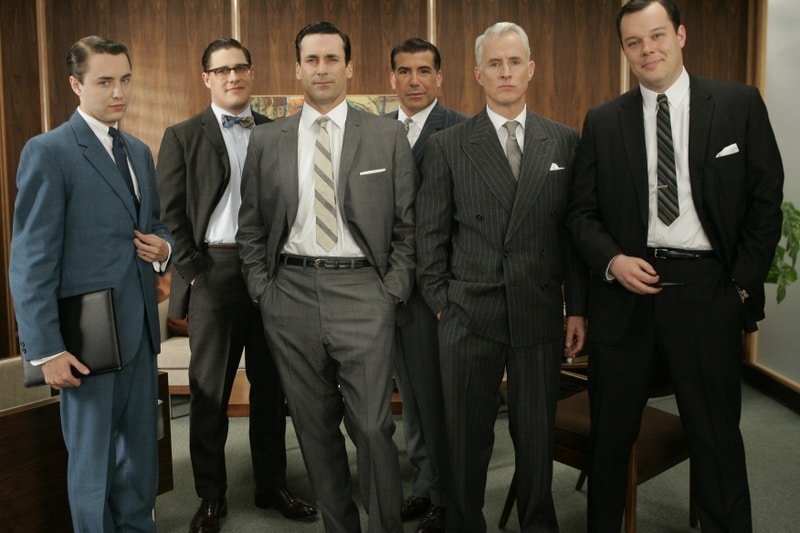
Painstaking historical accuracy. There are absolutely no anachronisms in any of the scenes from what I can see. Everything is perfect, from the ubiquitous cigarette present in every single adult character's hand to the 60's furniture to the beer cans that require a can opener to drink. The result of this careful attention to the construction of each set still has me in awe. Even the men's wardrobe was done perfectly! The cuffed dress pants, gray ad man suits with white pocket squares, skinny (shorter) ties with tie bars... the clothing was spot-on.
Socially accurate scriptwriting. In American history classes, I was taught about the changing social tides of each period. Mad Men has served to bring it to life, giving the whole history lesson a hands-on feel. Watching the show feels a little like learning science from a lab experiment in that instead of merely reading about the battle between sexism and feminism and the changing tones of racism in America, I can see the men behaving like rude perverts in the workplace (this was before the advent of regulations regarding sexual harassment) and the women making numerous antisemitic comments in their gossiping. Oh, what a different world it was.
Character development. Since Mad Men is a pure drama, with no flashy action scenes, character development becomes the key to keeping the audience's attention. At first, it felt like there were too many characters with their separate stories unfolding at the same time (not unlike movies like Love, Actually and Valentine's Day) and I thought I was going to have to quit watching before my brain exploded. However, the well-done historical nuances were able to keep me interested long enough to begin to understand each character's situation and begin to feel sympathies for each of them.
Realism and character depth. In Mad Men, there is no clean-cut "bad guy"; instead, we are given a bunch of individuals who are all living in the same world, all of whom are fitted with the full spectrum of human emotions, ambitions, and flaws. Each character has a story to tell and sees situations through a different perspective. Each character in the show can be analyzed at length and discussed for some educational learning value. Unlike the canonical sitcom (which does have its rightful place) and its instant gratification, watching Mad Men provides me with a more delayed gratification that is similar to that of reading an amazing novel one chapter at at time (and constantly analyzing it for meaning and symbolism).
Great music. The show frequently uses music that not only fits the setting of the show but also the content of the scenes. Also, the ingenious use of parts of Mozart's Marriage of Figaro during video clips of the Draper kid's birthday party taken by Don Draper definitely caught my attention.
Now, onto
What bothers me about Mad Men
What bothers me about the show is actually a backhanded compliment in that the production, direction, and script writing is so excellent that I get lost in the environment. The overall tone of the show seems like it is exposing what is commonly remembered positively as the period of flourishing suburbia and social and sexual revolution after World War II to be much more complicated and imperfect than imagined by most. When most of us think about the 60's, we immediately think "hippies" and free love and The Beatles--and while those were indeed important to the age, Mad Men lends a helping hand in bringing up many of the other gloomier qualities of the 1960s to light. The problem is that Mad Men is so convincingly done that I get caught up in this gloominess.
During the 1960s, my Dad moved to America after finishing his graduate studies in Taiwan and Japan. He lived and worked in the same America that Mad Men is portraying. He wore suits that were not unlike those worn by the ad men (he was vice pres of Comerica banks in my part of Texas) and used the outdated appliances of yesteryear. He behaved according to the manner and expectations of the time. He experienced the corporate pressures and the gloomy side of the 1960s. When I watch Mad Men, I start wondering about Dad's past and I tell myself, this is how he lived. I wish I could have started watching this show back when he was still alive. I'm sure we would have enjoyed it together. He would have had so many wonderful things to share with me about his time in America during the 60s. All this reflecting on Dad's past that comes from watching this show is bittersweet with a very depressing aspect, which is why I list it as something that bothers me.
In short, watching this show makes me gloomy and depressed, but these feelings are justified by how great it is.
I'm going to doubt anyone will read this entire post unless they are actually interested in either me or the show. Or maybe both, if you are that rare animal. This post pretty much happened as the satisfying of a spontaneous urge to express and understand my feelings about the series.



Recent Comments